
How many northern Sydney homes added a battery since the rebate started?
28,641 batteries across 64 postcodes in 14 months, or 127.4 for every 1,000 separate houses. The rate for Greater Sydney is 104.9, so northern Sydney is 21% ahead.
The gap is not about housing mix. Separate houses make up 55% of occupied homes in our area and 56% in the rest of Sydney, so the two areas start from a similar base. Northern Sydney homes are also choosing slightly larger systems: an average of 33.4 kWh of usable capacity per battery, against 32.7 kWh elsewhere in Sydney.
Scale 0 to 150. Sources: Clean Energy Regulator postcode data; ABS Census 2021, table G36.
Which northern Sydney postcodes have the most home batteries?
Kellyville and North Kellyville (2155) leads at 200.2 per 1,000 houses, followed by West Pennant Hills (2125) and Cherrybrook (2126). Church Point (2105) is lowest at 59.6. 39 of the 55 ranked postcodes beat the Greater Sydney rate.
The Hills District stands out: 6 of its 6 postcodes beat the Sydney average, and separate houses make up 82% of homes in Kellyville. At the other end, the last three ranked places all go to the Pittwater end of the Northern Beaches, with Avalon Beach second last. Postcodes with a suburb page on this site are linked, and apartment-heavy postcodes on the Lower North Shore are listed at the end without a rank.
| # | Postcode and main suburbs | Batteries | Separate houses | Per 1,000 houses |
|---|---|---|---|---|
| 1 | 2155 Kellyville, North KellyvilleHills District · 3,705 batteries, 18,502 houses | 3,705 | 18,502 | 200.2 |
| 2 | 2125 West Pennant HillsHills District · 848 batteries, 4,772 houses | 848 | 4,772 | 177.7 |
| 3 | 2126 CherrybrookHornsby · 828 batteries, 4,841 houses | 828 | 4,841 | 171.0 |
| 4 | 2154 Castle HillHills District · 1,612 batteries, 9,748 houses | 1,612 | 9,748 | 165.4 |
| 5 | 2158 Dural, Middle DuralHornsby · 350 batteries, 2,301 houses | 350 | 2,301 | 152.1 |
| 6 | 2153 Baulkham Hills, Winston HillsHills District · 2,361 batteries, 15,540 houses | 2,361 | 15,540 | 151.9 |
| 7 | 2122 Eastwood, MarsfieldRyde and Epping · 750 batteries, 4,946 houses | 750 | 4,946 | 151.6 |
| 8 | 2121 Epping, North EppingRyde and Epping · 859 batteries, 5,783 houses | 859 | 5,783 | 148.5 |
| 9 | 2156 Glenhaven, KenthurstHills District · 515 batteries, 3,567 houses | 515 | 3,567 | 144.4 |
| 10 | 2071 Killara, East KillaraUpper North Shore · 396 batteries, 2,893 houses | 396 | 2,893 | 136.9 |
| 11 | 2157 Glenorie, CanoelandsHills District · 160 batteries, 1,192 houses | 160 | 1,192 | 134.2 |
| 12 | 2075 St Ives, St Ives ChaseUpper North Shore · 658 batteries, 5,120 houses | 658 | 5,120 | 128.5 |
| 13 | 2113 Macquarie Park, North RydeRyde and Epping · 465 batteries, 3,671 houses | 465 | 3,671 | 126.7 |
| 14 | 2074 Turramurra, North TurramurraUpper North Shore · 731 batteries, 5,776 houses | 731 | 5,776 | 126.6 |
| 15 | 2084 Terrey Hills, Duffys ForestNorthern Beaches · 131 batteries, 1,047 houses | 131 | 1,047 | 125.1 |
| 16 | 2119 Beecroft, CheltenhamHornsby · 424 batteries, 3,402 houses | 424 | 3,402 | 124.6 |
| 17 | 2070 Lindfield, East LindfieldUpper North Shore · 376 batteries, 3,023 houses | 376 | 3,023 | 124.4 |
| 18 | 2104 BayviewNorthern Beaches · 109 batteries, 878 houses | 109 | 878 | 124.1 |
| 19 | 2085 Belrose, DavidsonNorthern Beaches · 392 batteries, 3,167 houses | 392 | 3,167 | 123.8 |
| 20 | 2081 Berowra, CowanHornsby · 206 batteries, 1,675 houses | 206 | 1,675 | 123.0 |
| 21 | 2102 WarriewoodNorthern Beaches · 173 batteries, 1,418 houses | 173 | 1,418 | 122.0 |
| 22 | 2082 Berowra Heights, Berowra WatersHornsby · 210 batteries, 1,734 houses | 210 | 1,734 | 121.1 |
| 23 | 2066 Lane Cove, Lane Cove NorthLower North Shore · 625 batteries, 5,186 houses | 625 | 5,186 | 120.5 |
| 24 | 2159 Galston, ArcadiaHornsby · 177 batteries, 1,473 houses | 177 | 1,473 | 120.2 |
| 25 | 2087 Forestville, Killarney HeightsNorthern Beaches · 436 batteries, 3,673 houses | 436 | 3,673 | 118.7 |
| 26 | 2079 Mount ColahHornsby · 265 batteries, 2,236 houses | 265 | 2,236 | 118.5 |
| 27 | 2072 GordonUpper North Shore · 171 batteries, 1,448 houses | 171 | 1,448 | 118.1 |
| 28 | 2073 Pymble, West PymbleUpper North Shore · 521 batteries, 4,458 houses | 521 | 4,458 | 116.9 |
| 29 | 2114 West Ryde, MeadowbankRyde and Epping · 450 batteries, 3,877 houses | 450 | 3,877 | 116.1 |
| 30 | 2096 Freshwater, QueenscliffNorthern Beaches · 267 batteries, 2,304 houses | 267 | 2,304 | 115.9 |
| 31 | 2103 Mona ValeNorthern Beaches · 245 batteries, 2,129 houses | 245 | 2,129 | 115.1 |
| 32 | 2093 Balgowlah, Manly ValeNorthern Beaches · 517 batteries, 4,499 houses | 517 | 4,499 | 114.9 |
| 33 | 2077 Hornsby, WaitaraHornsby · 717 batteries, 6,292 houses | 717 | 6,292 | 114.0 |
| 34 | 2076 Wahroonga, NormanhurstUpper North Shore · 718 batteries, 6,329 houses | 718 | 6,329 | 113.4 |
| 35 | 2112 Ryde, PutneyRyde and Epping · 686 batteries, 6,065 houses | 686 | 6,065 | 113.1 |
| 36 | 2111 Gladesville, Tennyson PointRyde and Epping · 311 batteries, 2,799 houses | 311 | 2,799 | 111.1 |
| 37 | 2069 Roseville, Castle CoveUpper North Shore · 406 batteries, 3,664 houses | 406 | 3,664 | 110.8 |
| 38 | 2063 NorthbridgeLower North Shore · 175 batteries, 1,588 houses | 175 | 1,588 | 110.2 |
| 39 | 2120 Thornleigh, Pennant HillsHornsby · 616 batteries, 5,648 houses | 616 | 5,648 | 109.1 |
| 40 | 2092 SeaforthNorthern Beaches · 205 batteries, 1,964 houses | 205 | 1,964 | 104.4 |
| 41 | 2068 Willoughby, North WilloughbyLower North Shore · 417 batteries, 4,068 houses | 417 | 4,068 | 102.5 |
| 42 | 2067 Chatswood, Chatswood WestLower North Shore · 318 batteries, 3,130 houses | 318 | 3,130 | 101.6 |
| 43 | 2086 Frenchs ForestNorthern Beaches · 376 batteries, 4,070 houses | 376 | 4,070 | 92.4 |
| 44 | 2100 Beacon Hill, Allambie HeightsNorthern Beaches · 489 batteries, 5,318 houses | 489 | 5,318 | 92.0 |
| 45 | 2110 Hunters Hill, WoolwichRyde and Epping · 205 batteries, 2,251 houses | 205 | 2,251 | 91.1 |
| 46 | 2083 Brooklyn, Dangar IslandHornsby · 56 batteries, 627 houses | 56 | 627 | 89.3 |
| 47 | 2101 Narrabeen, North NarrabeenNorthern Beaches · 336 batteries, 3,920 houses | 336 | 3,920 | 85.7 |
| 48 | 2088 MosmanLower North Shore · 344 batteries, 4,028 houses | 344 | 4,028 | 85.4 |
| 49 | 2097 Collaroy, Collaroy PlateauNorthern Beaches · 294 batteries, 3,510 houses | 294 | 3,510 | 83.8 |
| 50 | 2080 Mount Kuring-GaiHornsby · 46 batteries, 555 houses | 46 | 555 | 82.9 |
| 51 | 2106 NewportNorthern Beaches · 185 batteries, 2,271 houses | 185 | 2,271 | 81.5 |
| 52 | 2099 Dee Why, CromerNorthern Beaches · 517 batteries, 6,505 houses | 517 | 6,505 | 79.5 |
| 53 | 2108 Palm Beach, Great Mackerel BeachNorthern Beaches · 44 batteries, 628 houses | 44 | 628 | 70.1 |
| 54 | 2107 Avalon Beach, Bilgola PlateauNorthern Beaches · 310 batteries, 4,616 houses | 310 | 4,616 | 67.2 |
| 55 | 2105 Church Point, Scotland IslandNorthern Beaches · 42 batteries, 705 houses | 42 | 705 | 59.6 |
| Not ranked: separate houses are under 30% of homes in these postcodes | ||||
| Not ranked | 2095 Manly*Northern Beaches · 151 batteries, 790 houses | 151 | 790 | 191.1 |
| Not ranked | 2094 Fairlight*Northern Beaches · 102 batteries, 635 houses | 102 | 635 | 160.6 |
| Not ranked | 2064 Artarmon*Lower North Shore · 96 batteries, 820 houses | 96 | 820 | 117.1 |
| Not ranked | 2065 Wollstonecraft, St Leonards*Lower North Shore · 275 batteries, 2,607 houses | 275 | 2,607 | 105.5 |
| Not ranked | 2060 North Sydney, Waverton*Lower North Shore · 71 batteries, 686 houses | 71 | 686 | 103.5 |
| Not ranked | 2062 Cammeray*Lower North Shore · 73 batteries, 759 houses | 73 | 759 | 96.2 |
| Not ranked | 2090 Cremorne, Cremorne Point*Lower North Shore · 79 batteries, 1,018 houses | 79 | 1,018 | 77.6 |
* Separate houses make up less than 30% of homes in this postcode. Batteries on terraces and townhouses still count in the CER figure, so the rate per house runs high and the postcode is listed without a rank.
Postcodes with fewer than 500 separate houses are left out of the table (2061 and 2089) but count in the area totals. Region labels follow our service areas.
How has battery uptake changed month by month?
Installs rose from 6.8 per 1,000 houses in July 2025 to a peak of 24.4 in April 2026, then fell to 4.5 in May. Northern Sydney ran ahead of the rest of Sydney in every month.
The April spike lines up with the first change to the program. From 1 May 2026 the discount began stepping down every six months and was tiered by battery size, so larger batteries now get less support per kWh. In the area, 5,472 batteries went in during April alone, 19% of the 14-month total, and 24,374 went in before May.
Monthly battery installs per 1,000 houses from July 2025 to August 2026. Northern Sydney is higher than the rest of Greater Sydney in every month, peaking in April 2026 at 24.4 against 19.0.
Lighter bars: installers have 12 months to create certificates, so the CER says figures for recent months will keep rising.
Show the numbers as a table
| Month | Northern Sydney | Rest of Greater Sydney |
|---|---|---|
| Jul 2025 | 6.8 | 4.9 |
| Aug 2025 | 5.6 | 4.3 |
| Sep 2025 | 7.4 | 5.6 |
| Oct 2025 | 8.6 | 6.6 |
| Nov 2025 | 9.9 | 7.2 |
| Dec 2025 | 12.1 | 8.8 |
| Jan 2026 | 7.4 | 5.9 |
| Feb 2026 | 10.7 | 8.2 |
| Mar 2026 | 15.5 | 11.9 |
| Apr 2026 | 24.4 | 19.0 |
| May 2026 | 4.5 | 3.8 |
| Jun 2026 | 5.8 | 4.8 |
| Jul 2026 | 6.0 | 5.0 |
| Aug 2026 | 2.7 | 2.6 |
Battery size followed the same path. Across Greater Sydney the average usable capacity per battery rose from 18.9 kWh in July 2025 to 41.0 kWh in April 2026, then dropped to 24.1 kWh once support above 14 kWh was cut back.
Average usable battery capacity by month in Greater Sydney, rising from 18.9 kWh in July 2025 to 41.0 kWh in April 2026 and falling to 24.1 kWh in May 2026.
Show the numbers as a table
| Month | Greater Sydney |
|---|---|
| Jul 2025 | 18.9 |
| Aug 2025 | 21.6 |
| Sep 2025 | 25.4 |
| Oct 2025 | 28.8 |
| Nov 2025 | 31.4 |
| Dec 2025 | 35.5 |
| Jan 2026 | 35.5 |
| Feb 2026 | 37.0 |
| Mar 2026 | 38.8 |
| Apr 2026 | 41.0 |
| May 2026 | 24.1 |
| Jun 2026 | 27.4 |
| Jul 2026 | 27.6 |
| Aug 2026 | 28.3 |
Are the batteries going onto homes that already have solar?
Mostly, yes. Over the same 14 months the area registered 14,075 new solar installations and 28,641 batteries, or 2.0 batteries for every new solar system. At least 51% of the batteries went in beside panels already on the roof.
Every battery in the program has to be installed alongside new or existing solar panels, so batteries outnumbering new solar installations points to retrofits on roofs that already had panels. That matters at the switchboard. A retrofit often adds a second inverter beside the existing solar one, and both need their own protection and isolation at the board. The CER counts include upgrades to existing systems, so treat the ratio as a guide.
Why does an older switchboard often need work before a battery goes in?
A battery adds new circuits and isolation to the board, and often a second inverter. Older boards often lack the space or the RCD protection to take that, so they are upgraded first. These are the typical reasons we see; every home is different and the board is checked before a quote.
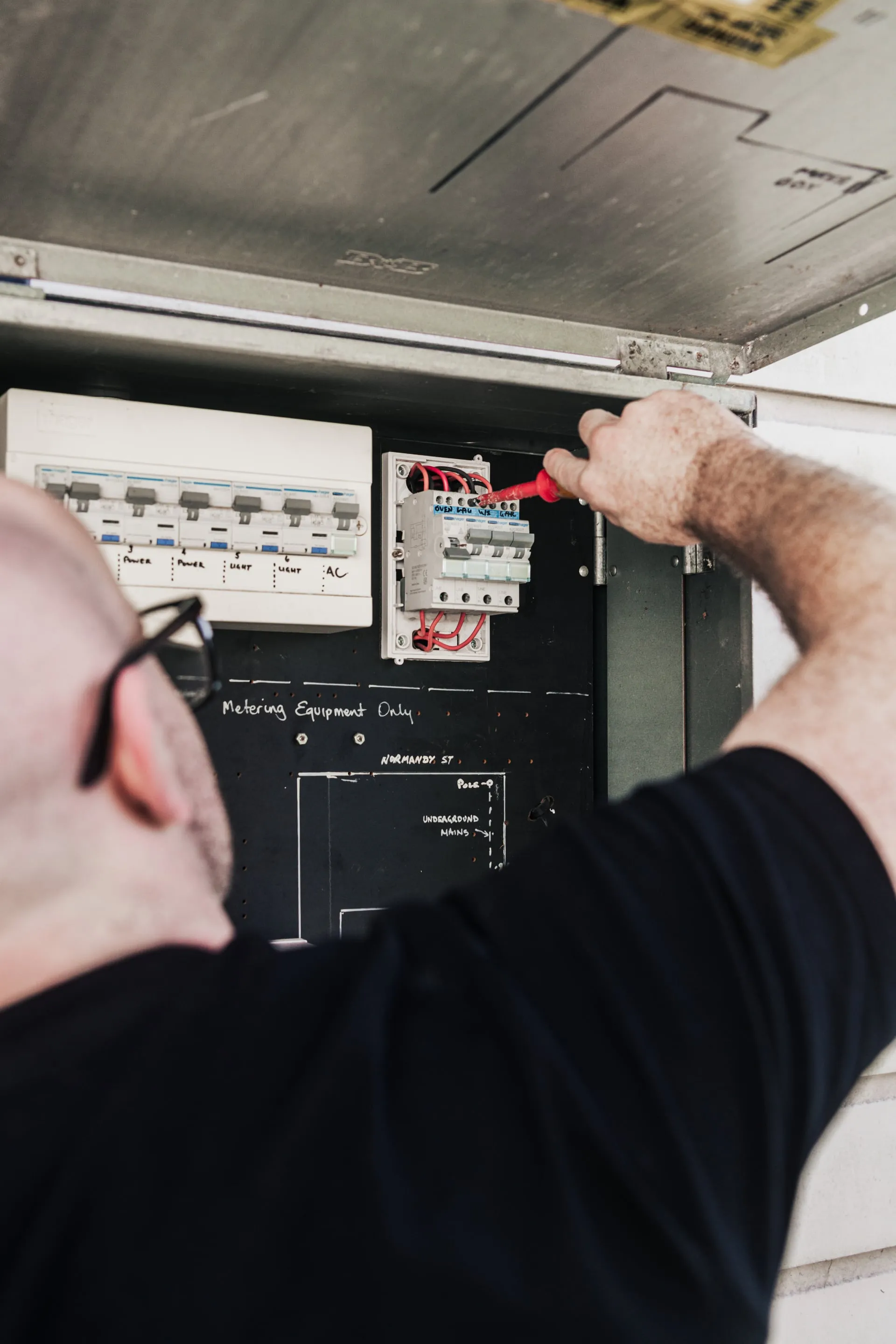
- Space on the board. The battery inverter needs its own circuit breaker, and an AC coupled system adds one more beside the existing solar breaker. Full boards, common after years of extensions, have no room left for those.
- RCD and RCBO protection. New circuits need safety switch protection under the wiring rules (AS/NZS 3000). Boards with ceramic fuses or one old safety switch are usually replaced with breakers and RCBOs at the same time.
- AC or DC coupling. AC coupling keeps the existing solar inverter and adds a battery inverter, which means two supplies into the board. DC coupling swaps the old solar inverter for a hybrid one. The CER requires the inverter the battery connects to be VPP capable.
- Isolation and signage. A battery is a second source of supply. Isolators and warning labels at the board tell anyone working on it that turning off the main switch does not make everything dead.
- Backup circuits. If you want lights and the fridge to stay on in an outage, those circuits are usually moved to a separate backed-up section or sub-board.
- Battery location. AS/NZS 5139 limits where a battery can go, including keeping it out of habitable rooms. That can set a longer cable run back to the board.
- Meter and network approvals. The installer applies to the network before connecting: Ausgrid across most of northern Sydney, Endeavour Energy in much of the Hills District. If the meter panel needs work, older panels may contain asbestos and are handled with the right precautions.
We install home batteries and upgrade switchboards for battery installs across northern Sydney. See home battery installation for how a job runs, or switchboard upgrades if you want the board ready before you choose a battery.
What rebates are there for home batteries in NSW?
The main one is the federal Cheaper Home Batteries Program, which started on 1 July 2025 and works through the Small-scale Renewable Energy Scheme. The NSW battery installation discount has closed for homes, but the NSW virtual power plant incentive is still available and can be combined with the federal discount.
Every line below comes from the official page linked beside it, checked on 8 October 2026. We have not quoted dollar amounts because they depend on the battery's size and its install date. Your installer or VPP provider will confirm the figure for your system.
The Australian Government's Cheaper Home Batteries Program started on 1 July 2025.
Source: NSW Climate and Energy Action, Install a battery (updated 1 July 2026). Checked 8 October 2026.
The discount works through the Small-scale Renewable Energy Scheme: an eligible battery can create small-scale technology certificates (STCs), and a registered agent can give you an upfront discount if you assign your right to claim the STCs to them.
Source: Clean Energy Regulator, Solar batteries (last updated 31 July 2026). Checked 8 October 2026.
The department describes the discount as around 30% of the upfront cost of installing a battery of 5 kWh to 100 kWh, for batteries connected to new or existing solar PV systems.
Source: DCCEEW, Cheaper Home Batteries Program (last updated 9 June 2026). Checked 8 October 2026.
To be eligible the battery must be on the Clean Energy Council approved battery list and be installed by a Solar Accreditation Australia (SAA) accredited installer with battery endorsement. It must comply with AS/NZS 5139:2019 and state electrical safety laws, and be capable of joining a virtual power plant if grid connected.
Source: Clean Energy Regulator, Solar batteries (last updated 31 July 2026). Checked 8 October 2026.
Only one battery per premises can claim STCs, and STCs can only be claimed for the first 50 kWh of usable capacity.
Source: Clean Energy Regulator, Solar batteries (last updated 31 July 2026). Checked 8 October 2026.
Changes took effect on 1 May 2026. The STC factor (STCs per kWh of usable capacity) now steps down every six months: 8.4 for January to April 2026, 6.8 for May to December 2026, 5.7 for January to June 2027, and down to 2.1 for July to December 2030.
Source: Clean Energy Regulator, Solar batteries (last updated 31 July 2026). Checked 8 October 2026.
Support is also tiered by size: the full STC factor applies up to 14 kWh, 60% of it for each kWh above 14 up to 28 kWh, and 15% for each kWh above 28 up to 50 kWh.
Source: Clean Energy Regulator, Solar batteries (last updated 31 July 2026). Checked 8 October 2026.
The battery should stay at the property for its warranty period or until the end of 2030, whichever is later.
Source: Clean Energy Regulator, Solar batteries (last updated 31 July 2026). Checked 8 October 2026.
The NSW Government's battery installation discount under the Peak Demand Reduction Scheme is no longer available for home and business owners. Installations that create certificates under the federal scheme cannot also claim the NSW installation incentive.
Source: NSW Climate and Energy Action, Install a battery (updated 1 July 2026). Checked 8 October 2026.
The NSW virtual power plant (VPP) incentive is available now with no current closing date. It is an upfront payment for connecting a battery to a VPP and can be combined with the federal discount.
Source: NSW Climate and Energy Action, Virtual power plant (VPP) incentive (updated 31 August 2026). Checked 8 October 2026.
From 1 July 2026, batteries of more than 2 kWh and up to 50 kWh are eligible for the VPP incentive. The amount depends on the usable capacity made available to the grid (up to 28 kWh) and on the VPP provider and contract you choose. It can be claimed once per meter (NMI). Batteries at apartment buildings are not eligible.
Source: NSW Climate and Energy Action, Virtual power plant (VPP) incentive (updated 31 August 2026). Checked 8 October 2026.